Platform strategy / Product modernization · Full-time role
Modernizing Mission-Critical Government Platforms at Scale
From custom state implementations to a shared, configurable product foundation
My role
From early platform planning to director-level product leadership
Environment
Brandt · state natural resources and parks agencies
Scope
State agencies across the country
The environment
At Brandt, our products supported state Departments of Natural Resources (DNR) and Parks agencies across the country.
The platforms supported a broad range of government services, including:
Recreational licensing and permitting: Hunting, fishing, and other recreational licenses and permits.
Commercial licensing and regulation: Licensing, permitting, and regulatory workflows for commercial activities.
Park reservations: Reservation systems supporting state parks and recreational facilities.
Vehicle registrations: Registration services administered through participating agencies.
Limited and quota-based hunt draws: Application and selection processes for hunting opportunities with restricted availability.
Digital form submission and approval workflows: Applications requiring agency review, evaluation, and approval, extending beyond traditional over-the-counter license and permit purchases.
In some states, our products served both natural resources and parks agencies, adding another layer of operational and regulatory complexity.
Together, these systems supported diverse government operations and handled tens of millions of customer records and transactions.
The challenge
Historically, launching a new state implementation could require 12–18 months of development and customization.
Although agencies shared many underlying needs, differences in regulations, workflows, and operational preferences often resulted in state-specific development.
The opportunity was to evolve these implementations into a more reusable platform, reducing the need for custom development while retaining the flexibility individual agencies required.
At the same time, modernization involved large volumes of customer and transactional data. Preserving the integrity of that data and maintaining service availability were critical requirements.
The strategy: make common requirements configurable
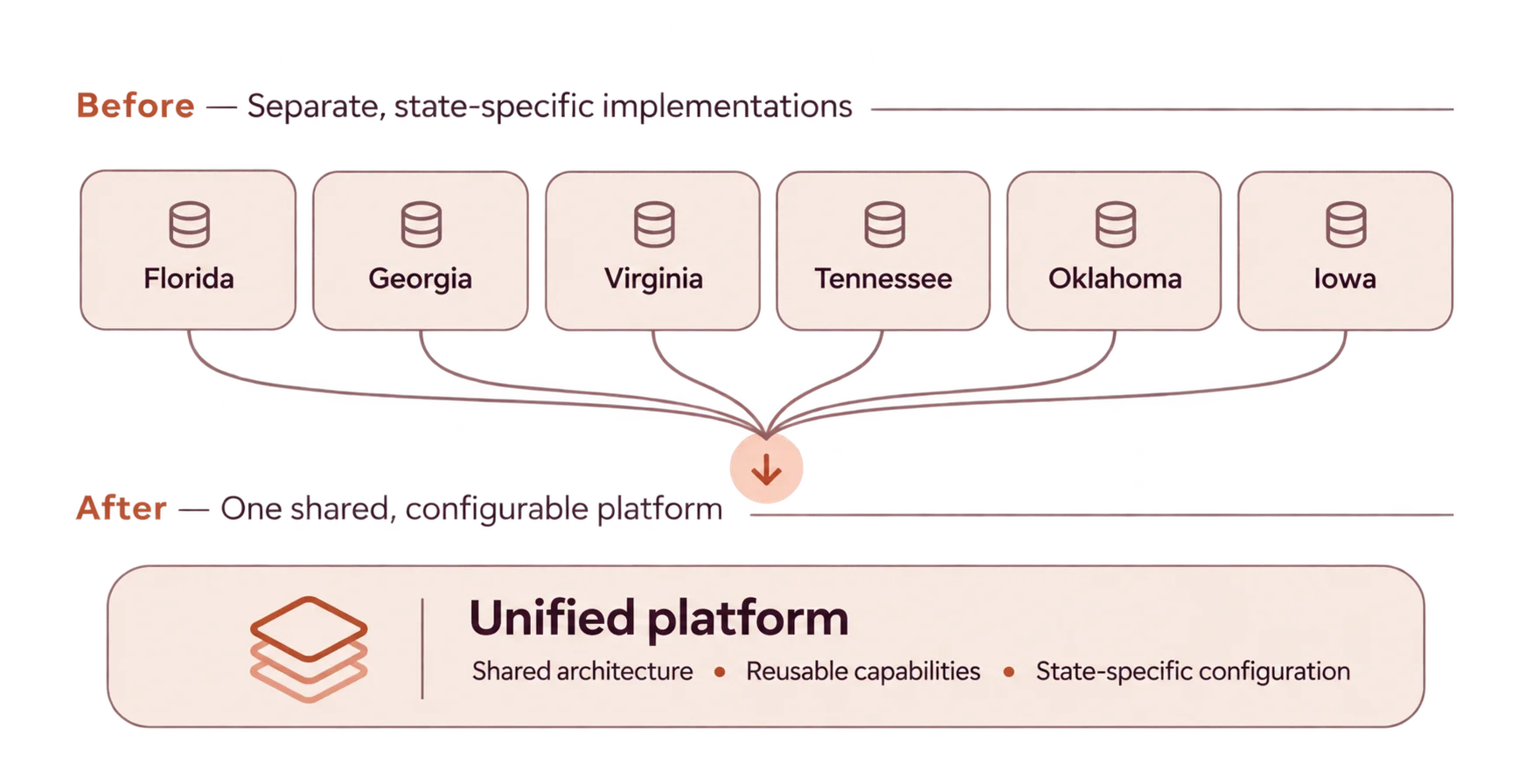
Rather than continuing to solve similar requests independently for each state, we progressively incorporated recurring requirements into the shared product.
Functionality that previously required custom development could increasingly be configured to reflect an agency’s preferences.
This allowed the platform to mature with each implementation, expanding its out-of-the-box capabilities and reducing the frequency of custom development.
From fragmented, state-specific implementations to a shared platform approach. Conceptual illustration, not actual architecture.
One codebase, independently hosted agency environments
The platform’s architecture had to balance two competing priorities: the efficiency of a shared product and the regulatory requirements of individual government agencies.
Each agency maintained its own dedicated servers and database, providing separation at both the application hosting and data layers.
Rather than consolidating agencies into a traditional shared-infrastructure SaaS environment, we adopted a common application codebase that could be deployed independently for each agency.
One shared codebase
Reusable capabilities · Configurable features · Independently deployed environments
Shared application codebase
One product foundation across agencies
FloridaDedicated servers + database
GeorgiaDedicated servers + database
VirginiaDedicated servers + database
TennesseeDedicated servers + database
OklahomaDedicated servers + database
IowaDedicated servers + database
Conceptual illustration · Not a verified infrastructure diagram
This allowed us to develop reusable functionality, standardize product capabilities, and support agency-specific configuration while preserving the infrastructure and data separation required by our clients.
The strategic challenge wasn’t simply sharing code. It was ensuring that new requirements strengthened the common product rather than introducing unnecessary agency-specific variations.
Over time, we shifted from building custom functionality for individual implementations toward developing configurable capabilities that could serve multiple agencies.
Executing modernization without disrupting operations
The transition also required carefully coordinated database migrations involving large volumes of customer records and transactions across the platform environment.
Major migrations were executed within planned overnight maintenance windows, with less than six hours of downtime.
The work was completed without unplanned service interruptions, preserving operational continuity for the agencies relying on these systems.
The impact
Faster implementations through product maturity
As the platform evolved, implementation timelines became substantially more flexible.
Platform strategy / Product modernization
Building once. Configuring for many.
Evolving a multi-state regulatory licensing platform from lengthy, state-specific implementations toward reusable capabilities and configurable workflows.
Earlier implementations
12–18 months
Build and customization
Later smaller projects
3–5 months
Implementation and onboarding
Different project scopes and periods; not a controlled like-for-like comparison.
Where earlier projects could require approximately 12–18 months of development and customization, some smaller implementations could be completed in as little as 3–5 months.
Although these projects varied in scope, the change reflected a broader product evolution: new agency implementations could increasingly leverage established capabilities instead of requiring extensive new development.
Supporting company growth and national competitiveness
The shift toward a shared, configurable platform also supported a broader transformation in Brandt’s product business.
By reducing reliance on state-specific development and expanding the functionality available out of the box, the organization developed a more scalable foundation for pursuing and delivering government contracts.
This evolution helped position Brandt to compete nationally against longstanding industry vendors, while supporting an expanding portfolio of government agency partnerships.
During the broader period of company growth, Brandt developed from a relatively small organization into an established national technology provider, now reporting more than 325 employees and partnerships with 28 government agencies.
Platform modernization was one contributor to that growth, alongside the company’s broader commercial strategy, acquisitions, and organizational expansion.
My contribution
My involvement began early in my product career, when I participated in the initial conceptualization, architecture discussions, and planning of the shared-platform approach. As my responsibilities grew, I helped translate that vision into the way our product teams approached development, moving from state-specific solutions toward a single-codebase mindset built around reusable and configurable functionality.
A significant part of my leadership involved developing this way of thinking across the product organization. I trained and guided Product Managers to evaluate new requirements beyond the needs of an individual agency, considering how functionality could be designed to accommodate multiple regulatory environments, operational workflows, and future implementations.
I also led new client go-lives, working directly with government agency stakeholders through multiple onsite visits. These engagements involved walking through complex user workflows, understanding operational and regulatory requirements firsthand, and translating those needs into actionable direction for development teams.
As the organization grew, I trained Product Managers to lead these same discovery and implementation activities, extending our ability to manage complex client relationships and deliver new implementations consistently.
My involvement continued beyond initial launches. I led the introduction of new functionality as regulatory requirements changed and industry needs evolved, then monitored how those changes performed in practice. This ongoing feedback helped inform subsequent product decisions and identify opportunities to expand configurable, out-of-the-box capabilities.
Throughout this work, my role connected long-term platform strategy with practical execution: understanding agency needs, guiding product decisions, developing product talent, and helping the organization build for the broader platform rather than individual implementations.
Key takeaway
The goal wasn’t simply to consolidate software. It was to build a product that became more capable and easier to implement with every new agency we supported, without compromising the continuity of existing services.
That evolution also demonstrated how thoughtful platform strategy could support business growth: enabling a company to expand its capabilities, serve more customers, and compete in a market historically served by established vendors.